Chat is the interface. Intelligence is the product.
A chatbot answers questions. ScopeLoop is doing something else while it talks: reading each answer against your services, your prices and your past projects, and writing structured evidence you can act on. The conversation is the easy half.
The conversation is handed to the client before it is written to the database. Nobody waits on our bookkeeping.
The discovery surface renders in your brand and says plainly that it is running intake for you. Hiding it would be the fastest way to lose the trust the conversation depends on.
Modern, creative or corporate. Different question sets and different surfaces, not one template recoloured.
Five stages. Nothing re-typed between them.
The evidence captured in the first conversation is the same evidence that scores the opportunity, prices the proposal and briefs delivery.
Discover
9 questions · answered in the client's own timeSend a link or embed the widget on your own site. One question at a time, in your voice, each one shaped by the answer before it. The client never fills in a form.
The answer you need is whether to bother.
Every completed session gets a rating out of five, the reasoning behind it, a likely value from your own rate card, and a stated confidence. Low confidence says so rather than dressing up a guess.
Strong fit
Worth prioritising this week.They named a commercial driver, a signed-off figure and their own authority to spend it in the same conversation. The scope resembles three projects you closed profitably in hospitality. Timeline is the only soft spot: spring is stated as a preference, not a deadline.
Estimated from your rate card and past closed work.
Backed by specific answers on scope, budget and timing.
Send the draft this week while the aggregator commission is still the number on their mind. Pin the timeline before you commit the team.
The draft is waiting when the call ends.
Scope, phases, deliverables, exclusions and fee, written from the transcript and your own past proposals. You edit rather than start.
Delivery starts with the context already organised.
When a proposal is accepted, ScopeLoop writes the handover — everything delivery needs that never made it into the proposal. Then it stops. Nothing here tracks progress, because the moment it did, this would be pretending to be a project tool.
It is not a CRM. It does not manage the project, track time or invoice. It hands the pack to wherever the work actually gets run, and gets out of the way.
It gets better because it knows your agency, not because the model got bigger.
Import your own site and ScopeLoop builds the Brain: what you sell, what it costs, who you are good for, and what you decline. Every discovery conversation is written against it, and every closed project sharpens it.
Eight parts of one system.
Discovery isn’t one feature bolted onto a form — it’s a straight line from a prospect’s website through the conversation, the evidence it produces, the verdict, the proposal and the handover. Nothing below is a mock-up of a plan; it’s what the running product actually does at each step.
One question at a time, in your voice, shaped by every answer before it — and it is already reading each answer for the facts that matter while the client just sees a conversation.
Paste a domain and it reads their site before you ever speak — claims about the business, each with the sentence it came from.
“Everything goes through the aggregators and we lose 18% on every room.”
Loose talk becomes named fields, merged turn by turn. An empty answer never overwrites something already known.
One to five stars with the reasoning, a likely value from your own rate card, and a stated confidence.
Scope, phases, exclusions and a fee band, drawn from the transcript and your own past proposals.
What each side owes, what is blocking, and every risk flagged during discovery. Then it stops.
One script tag puts discovery on your own site as a bubble. Scroll-locked, full screen on mobile, and it cannot leak styles either way.
Owner, admin, manager and member. Everyone sees the same opportunity, and nobody can act on a role they do not outrank.
What using it actually feels like.
Three questions, in the order you ask them each morning: what is waiting on me, what is the pipeline worth, and what happened while I was away.
The workspace is dark because it is a decision surface, not a document — verdicts, figures and queues. Everything your client sees stays light and in your brand.
Your client never sees a form.
They open a page in your brand and answer in their own words. Three templates render the same conversation — choose one, set a colour and a logo, and it is yours. Send it as a link, or embed the same conversation on the site you already have.
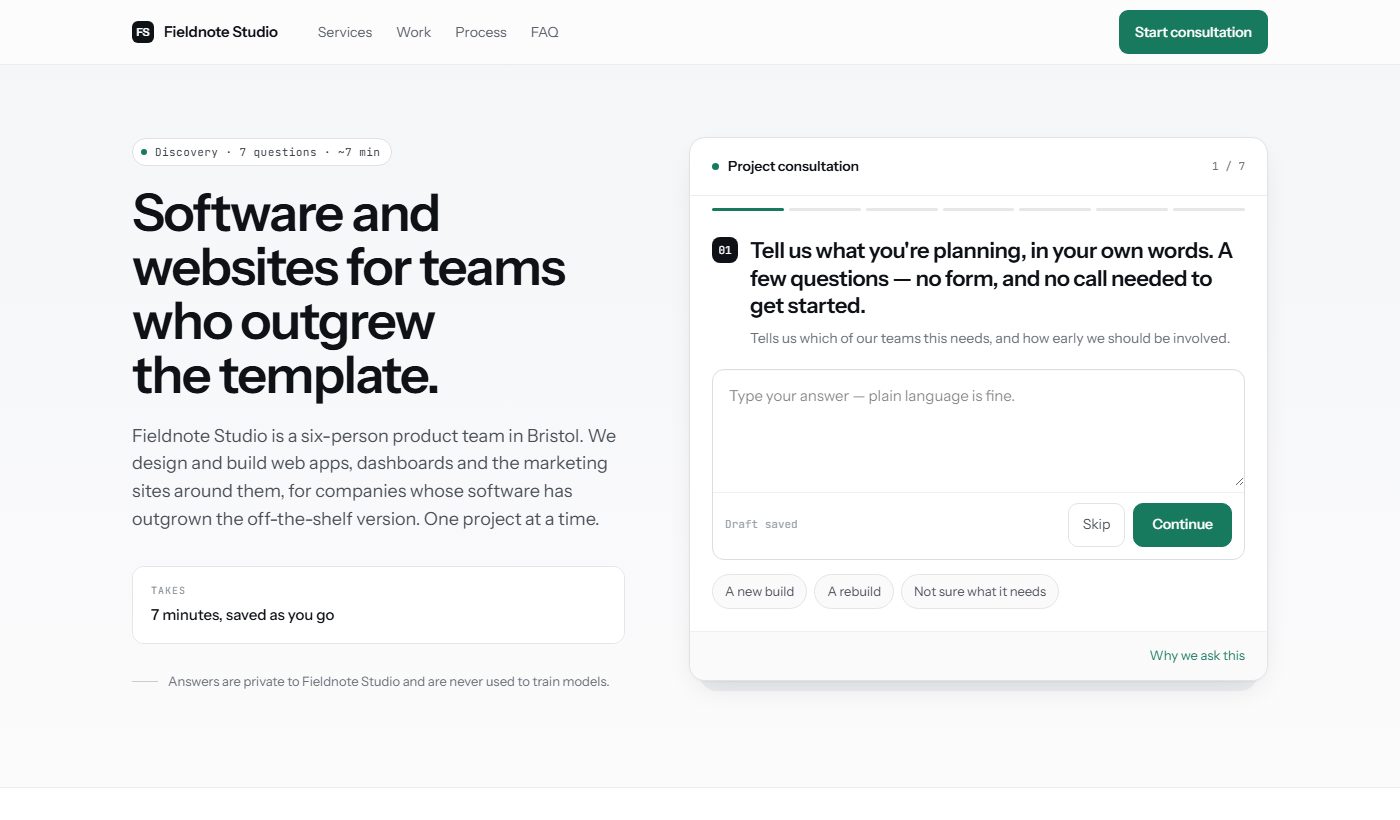
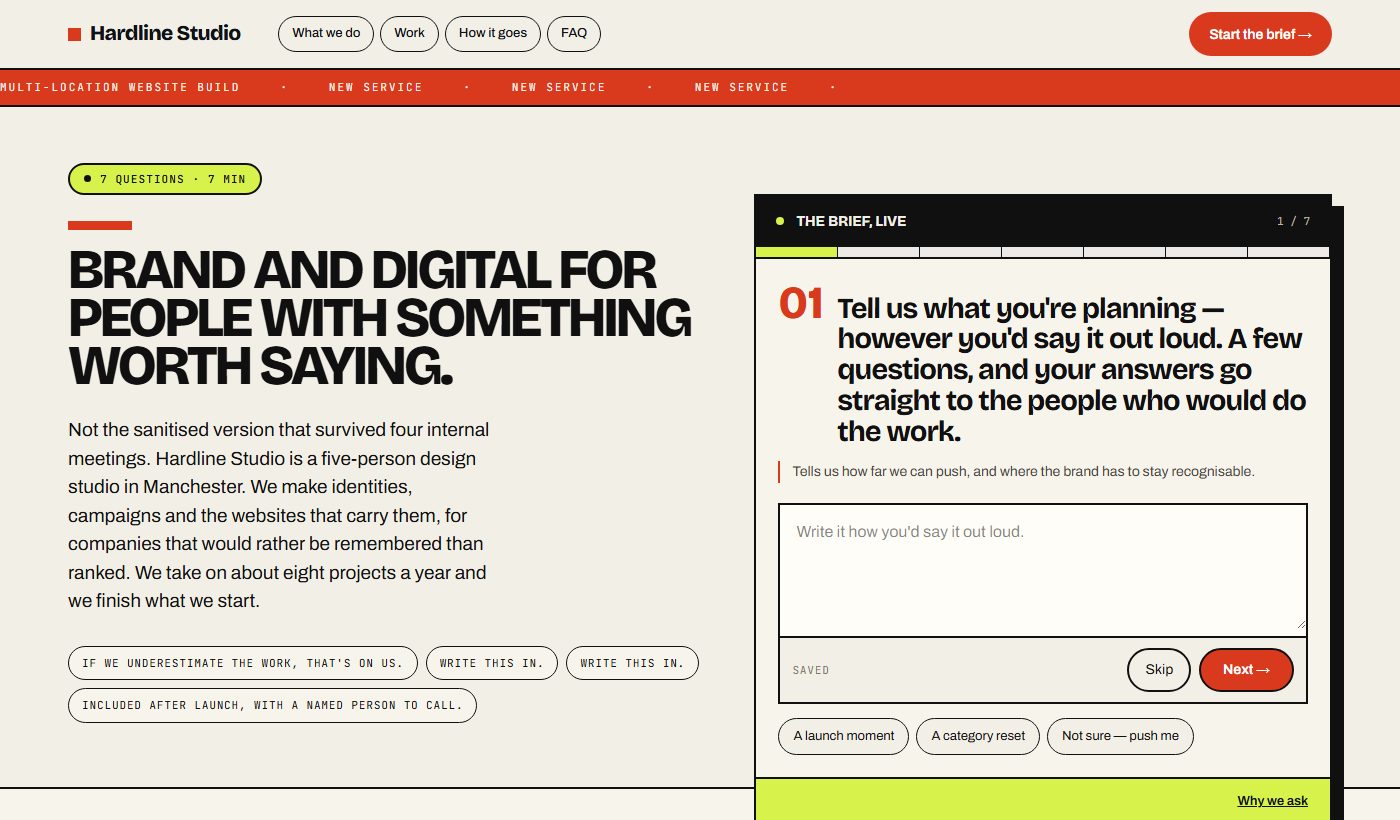
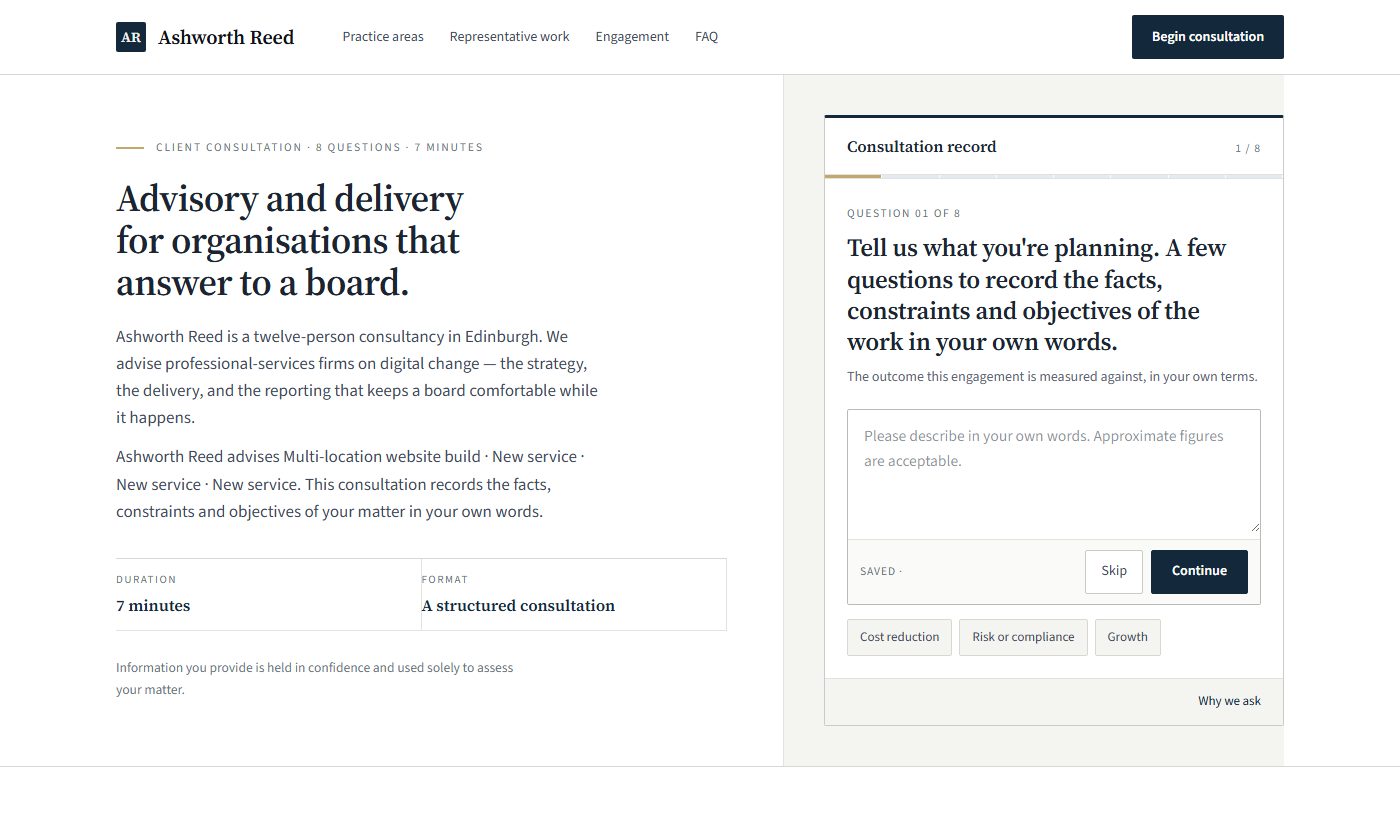
Each question follows from the last one they answered. A form asks all seven of everyone, and gets four back.
Template, colour, logo and wording belong to the agency. Nothing on the page carries our name.
One address you can send, or the same conversation in the corner of your own site. It is one session either way.
Every answer arrives as evidence on the brief you read. Your client is only ever having a conversation.
Priced on completed intakes, not seats.
A client who opens the page, types one line and leaves costs you nothing. Only completed conversations count.
Trying it on real enquiries
A steady trickle of enquiries
When enquiries are the constraint
High volume, no limits
Plan names, prices and features render from plans.ts. We do not sell unlimited AI — Scale is generous fair-use headroom, not a promise the backend cannot meter.
The ones agencies actually ask.
Yes. The discovery surface renders in your brand and says plainly that it is an assistant running the intake for you. Hiding it would be the fastest way to lose the trust the conversation depends on.
Stop writing proposals
on a Sunday.
Five free intakes a month, no credit card. Point it at your own site and it will know what you sell before your first conversation.